A procurement engineer I know ordered 40 induction coils last spring. Two quotes landed in his inbox that same week. One was 31% cheaper and promised "fully dense, same conductivity." The other one cost more but put IACS, density, and laser wavelength in the first email. He took the cheap one. Five weeks later half the coils ran hot at 60% of rated power. The vendor's answer: "porosity is normal in copper 3D printing." It's not. That's the difference between buying copper 3D printing from a machine shop and buying it from someone who actually understands copper.
Why Cheap Copper Quotes Fail
Most copper projects that fail fail at the quoting stage. Pure copper is the hardest metal to print with an infrared laser. Copper reflects most of the 1064 nm beam. The energy bounces off instead of melting the powder. What you get is porosity, weak bonds, and conductivity that looks fine on paper but drops below 85% IACS in real parts.
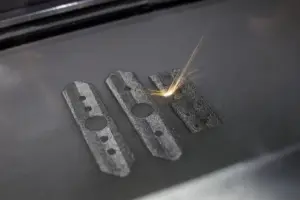
That's why the cheap quote fails. The machine is fighting the material from layer one. Shops that do copper 3D printing for a living use a green laser at 515 nm because copper absorbs that wavelength far better. One change in wavelength separates dense parts from spongy ones.
When a quote does not mention the laser source, ask why not. When it skips powder quality, ask again. Real copper jobs run gas-atomized spherical powder at 99.9% purity or better. Powder is where corners get cut first. Porosity is where the bill lands later.
Read the IACS Number, Not Just the Price
Conductivity is the whole point of copper 3D printing. If the part does not carry current or move heat, you don't need copper. So the first number to verify is IACS, the conductivity measured against annealed copper wire.
| Material | Conductivity (% IACS) | Thermal (W/m·K) | Tensile (MPa) |
|---|---|---|---|
| Printed pure copper, HIP + annealed | 95–98 | ~390 | 200–260 |
| As-printed pure copper | lower, varies | lower | up to ~350 |
| Beryllium copper | 15–45 | ~105–230 | 410–1380 |
| Brass | 26–28 | ~109–121 | 310–550 |
IACS is the spec that separates real parts from decorative ones. Optimized, post-processed pure copper hits 95–98% IACS, close to wrought copper. BeCu and brass keep showing up in cheap quotes. They print easier. They conduct way less. Now you know why.
A supplier that says "good conductivity" but gives no number? That supplier has no number. Ask for written IACS plus the test method, four-point probe or eddy current. Ask what condition it was measured in. As-printed copper is stronger but less conductive, and it's not the state you want for current-carrying parts.
Green Laser vs Infrared: The Spec Sheet Tells the Truth
Green-laser LPBF reaches relative density of 99.5% or higher, typically 99.7–99.9% on validated geometries. Typical windows: laser power 190–500 W, scan speeds 500–1250 mm/s, layer thickness 15–60 μm.
Ask for the dimensional capabilities too. Realistic numbers: ±0.1 mm on small features, 0.4–0.5 mm walls, 0.3–0.5 mm features. An infrared machine can quote the same numbers. The difference shows up in the acceptance part, not in the email.
Get a sample instead. One test coupon printed on their line beats a five-page capability statement. Measure density. Measure conductivity. That's the whole review. If the vendor hesitates on a sample, that's your answer.
Five Questions to Ask Before You Order
Before you commit to a copper 3D printing vendor, run these five questions.
Which process? Laser powder bed fusion for precision small-to-medium parts, binder jetting for mid-to-high volume, DED for large parts and repair. Match the process to the part.
What density do you guarantee? Written, not verbal. Look for 99.5% or better on the geometry you're actually buying.
Do you HIP and anneal? HIP closes microporosity. Annealing at 400–600 °C restores ductility and conductivity. If the answer is no, walk.
What accuracy do I get? ±0.1 mm is typical. Tighter features mean CNC finishing on top of printing.
What's the delivered finish? Electropolished surfaces run below Ra 1.6 μm. Silver plating cuts skin-effect loss at high frequencies. Ask which one your application needs.
Post-Processing Is Half the Copper Part
Quotes that skip post-processing are incomplete quotes. Nobody should ship as-printed copper for conductive duty. HIP closes residual microporosity. Annealing restores the ductility and conductivity you actually paid for. CNC machining tightens mating features down to ±0.01 mm. Electropolishing drops surface roughness. Silver plating helps high-frequency parts. Electroless nickel protects against harsh coolant.
The gap between average copper 3D printing and good copper 3D printing is almost always post-processing. A part is only as good as its delivery condition, and that condition is a written spec. Ask what happens between the last layer and the shipping box, and get it in writing.
Where Copper 3D Printing Actually Wins
Here's where copper 3D printing pays for itself. Start with parts machining and casting cannot make. Induction coils with conformal cooling channels last about twice as long as brazed copper coils. Heat exchangers with TPMS or lattice channels get 30–60% more heat-transfer area. RF waveguides with complex internal geometry reduce signal loss. Motor winding prototypes validate cooling structures before production. Electrical contacts run low resistance at high current.
Simple external geometry at high volume? CNC wins, no argument. But once the design needs internal complexity, copper 3D printing is often the only option that exists.
Quick Answers on Copper 3D Printing
Can pure copper be 3D printed? Yes. LPBF with green laser and binder jetting are the established industrial methods. FDM is not for dense copper.
What conductivity should I expect? 95–98% IACS in the HIP + annealed condition, close to wrought copper.
What's the minimum feature size? Typically 0.3–0.5 mm for features, 0.4–0.5 mm for walls.
Is copper AM expensive? Compared to steel, sure. Compared to brazed-joint failures and scrap piles, usually not. The breakeven moves fast on parts with internal channels.
How long does copper 3D printing take? Prototypes usually ship in days, not months. Lead time depends on geometry, post-processing, and queue.
How do I know a supplier can actually do it? Ask for a sample, the IACS test report, and a green-laser machine list.
Send your drawing and target IACS to our engineering team. They run electromagnetic simulation and CFD before the first layer. Whether you need copper 3D printing for a prototype or a pilot run, we can help. Start with our pure copper 3D printing page for full specs, check copper additive manufacturing for process options, and see 3D printed induction coils for the application that pays for itself. Or send your enquiry through the contact page and we'll match the process to your part.