
If you manage production for an automotive parts supplier, you already know the frustration. A new motor housing or turbo component lands on the floor. Your 3-axis machines need four or five setups just to reach every face and undercut. Each time the part is unclamped and flipped, a little error creeps in. By the time it reaches final inspection the tolerance stack-up has eaten your margin, scrap is climbing, and the customer is already asking why the shipment is late again.
That is the exact reason more OEMs and Tier-1 suppliers are moving their toughest Precision CNC Milling work onto 5-axis machines. It is not about buying the newest equipment for the brochure. It is about cutting the number of times a part is touched, keeping every feature locked to the original datum, and delivering tight-tolerance parts without the usual drama.
The Real Problem with Traditional 3-Axis Milling for Car Parts
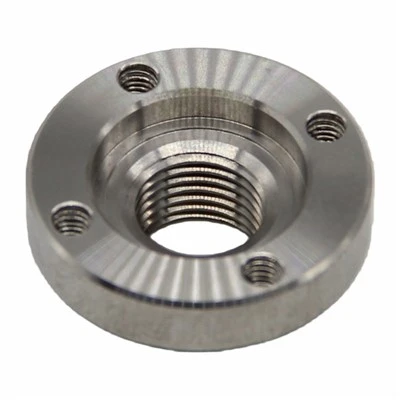
Multiple setups create more room for error
Every re-fixture introduces a small relocation error - commonly 0.025–0.13 mm. On a transmission case or EV motor housing that needs features on five sides, those errors add up fast. One supplier we worked with saw 0.18 mm of cumulative error across twelve bore locations; nearly half of it came from fixture shifts. When the print demands true position inside 0.05 mm, that stack-up turns into scrap or expensive rework.
Complex geometries that 3-axis simply cannot reach cleanly
Engine housings with internal oil galleries, turbocharger wheels, thin-wall aluminum suspension knuckles, and the cooling channels inside EV motor structures all have undercuts, compound angles, or continuous free-form surfaces. A 3-axis machine either needs special angle heads and multiple fixtures or leaves steps and inconsistent surface finish. The result is longer cycle times, extra secondary operations, and quality that varies from batch to batch.
In short, the more setups you need, the harder it becomes to hold consistent High Tolerance Milling results across a production run.
What Makes 5-Axis Machining Different (in Plain English)
A 3-axis machine moves the tool up-down, left-right, and front-back. A 5-axis machine adds two rotary axes so the cutter (or the part) can tilt and swivel. The tool can approach the workpiece from almost any direction while the part stays locked in one fixture.
One setup, multiple angles - why that matters for Precision CNC Milling
Because the part never leaves the original datum, every hole, face, and contour is cut relative to the same zero point. Positional accuracy between features stays within the machine's own repeatability instead of accumulating fixture error. That single-setup approach is the practical foundation of reliable Precision CNC Milling on complex parts.
Where High Tolerance Milling actually comes from
High tolerance does not magically appear because the machine has extra axes. It comes from removing the variables that destroy accuracy - re-fixturing, thermal differences between machines, and operator handling. When everything happens in one continuous process, the machine can keep better tool engagement angles, lower cutting forces, and more consistent surface finish. The result is tighter true-position and form accuracy without heroic effort from the operator.
Why Automotive Companies Specifically Need This
Automotive designs keep getting more complex while weight and packaging constraints tighten. The parts that benefit most include:
Engine and cylinder-head components with complex coolant and oil passages
Transmission and differential housings that need precise bore alignment
Turbocharger and compressor housings with free-form aerodynamic surfaces
EV motor housings, stator supports, and structural battery-tray members
Lightweight aluminum suspension knuckles, control arms, and sensor brackets
Integrated sensor mounts and thermal-management plates that qualify as Complex Milling Components
In the shift to electric vehicles, many of these parts combine thin-wall aluminum with tight geometric tolerances. Multi-axis milling services let manufacturers machine the entire part in one or two setups, preserving the relationship between critical features and cutting overall lead time.
The Data Behind the Shift
Market research consistently shows steady growth in 5-axis equipment because of these demands. The global 5-axis CNC machining centers market is projected to expand at a CAGR of roughly 6–8 % over the next several years, with the automotive segment accounting for around 25–30 % of demand. Adoption is particularly strong in regions with heavy EV production because the geometry of motor housings, battery enclosures, and structural castings cannot be produced efficiently on conventional 3-axis equipment.
Shops that move high-precision automotive work to multi-axis platforms typically report setup reductions of 50–75 %, scrap-rate drops of 70 % or more on complex parts, and cycle-time improvements that more than offset the higher machine-hour rate. The numbers are no longer theoretical - they show up clearly in the purchasing patterns of both OEMs and their Tier-1 suppliers.
Case Study - How Sunhingstones Solved a Real Tolerance Problem
A mid-sized Tier-2 supplier was producing aluminum EV motor housings for a European OEM. The drawing required several critical bores and mounting faces held to ±0.02 mm true position relative to a common datum. On their existing 3-axis cells the parts needed four setups. Cumulative error pushed the true-position results right to the edge of tolerance (and sometimes over). First-pass yield sat around 82–85 %, and the extra inspection plus rework were stretching delivery by nearly two weeks on every batch.
We reviewed the process with them and proposed a single-setup approach on a simultaneous 5-axis machine with in-process probing. The blank was clamped once on a dedicated fixture that exposed all required surfaces. The program machined every bore, face, and mounting feature from the same zero point, with the probe checking critical dimensions before the finish passes.
After the first production lots the results were clear:
True-position capability moved from roughly Cpk 0.9 into the 1.5–1.7 range
First-pass yield climbed above 97 %
Total time from blank to finished part (including setup) dropped by just over 40 %
The two-week delivery buffer was recovered, and the customer increased the order volume
Nothing exotic was required - just removing the stack-up that had been built into the old process.
How to Choose the Right CNC Milling Manufacturer / Factory
When you start looking for a reliable CNC milling manufacturer or CNC milling factory for automotive work, focus on practical capability rather than marketing language. Here is a short checklist that has proven useful:
Certifications and quality systems - ISO 9001 is baseline; IATF 16949 or an equivalent automotive quality system is strongly preferred.
Actual 5-axis equipment and capacity - Ask for the machine list, spindle power, and whether simultaneous five-axis (not only 3+2) is available.
Process capability data - Request recent Cpk or PpK results on similar materials and tolerances.
Prototyping and first-article speed - Can they turn a new part around in days rather than weeks?
Batch-delivery reliability - Look at on-time delivery history and how they handle volume ramps.
Material and secondary-process range - Aluminum, steel, stainless, and the ability to coordinate heat-treat, anodizing, or coating without losing dimensional control.
Engineering support - Do they offer practical DFM feedback that can reduce cost or improve manufacturability before the first chip is cut?
A good partner will answer these points with data and examples rather than general claims.
Comparison: 3-Axis vs 5-Axis for Typical Automotive Precision Parts
|
Aspect |
Traditional 3-Axis |
5-Axis CNC Machining |
|
Number of setups |
3–6 typical for multi-face parts |
Usually 1 (sometimes 2) |
|
Tolerance stack-up risk |
High – each re-fixture adds error |
Low – single datum maintained |
|
Ability to machine undercuts & free-form surfaces |
Limited or requires special tooling |
Direct access from optimal tool angles |
|
Cycle time on complex parts |
Longer due to multiple ops and handling |
Often 30–60 % shorter overall |
|
First-pass yield on tight-tolerance work |
Variable, often 80–90 % |
Typically 95 %+ when process is stable |
|
Best suited for |
Simple prismatic parts, high-volume flats |
Complex Milling Components, high-tolerance automotive parts |
FAQ
Q: What is 5-axis CNC machining used for in the automotive industry?
A: It is used for engine and transmission housings, turbo components, EV motor structures, lightweight aluminum suspension parts, sensor brackets, and any other Complex Milling Components that require multi-face access and tight geometric tolerances in a single setup.
Q: How does 5-axis machining improve tolerance accuracy?
A: By completing almost all machining in one clamping, it eliminates the relocation errors that accumulate with multiple setups. Features stay referenced to the original datum, so true-position and form tolerances become much easier to hold consistently.
Q: Is 5-axis milling more expensive than 3-axis?
A: The machine-hour rate is higher, but the total cost per part is often lower because of fewer setups, less scrap, shorter lead times, and reduced secondary operations. On complex automotive parts the net cost advantage usually appears within the first few production batches.
Q: What automotive parts benefit most from complex milling components?
A: Parts with free-form surfaces, undercuts, compound angles, or multiple critical datums - especially EV motor housings, turbocharger components, integrated structural brackets, and lightweight aluminum chassis pieces.
Q: How do I find a reliable CNC milling manufacturer for automotive parts?
A: Look for IATF 16949 (or equivalent) certification, a clear five-axis machine list, documented process capability on similar work, fast prototyping turnaround, and a solid track record of on-time delivery. Ask for a recent capability example on a part close to yours.