
The prototype passed every thermal test in the lab. Then volume production started and field returns began climbing. Devices throttled under load, customers complained about unexpected shutdowns, and the repair queue grew. In many of these cases the root cause is not the chip or the firmware-it is the heat sink. When the geometry, material, or manufacturing process cannot move heat away fast enough, everything else suffers. A CNC milled heat sink is often the right answer for custom shapes, tight flatness, integrated features, and low-to-medium volumes. This article explains when and why.
Why Electronics Overheat
Heat starts at the semiconductor junction, travels through the package and thermal interface material into the heat-sink base, spreads across the base, and finally leaves through the fins into the surrounding air (or liquid). Any bottleneck in that path raises junction temperature.
A widely used industry rule of thumb, rooted in the Arrhenius relationship, states that for many electronic failure mechanisms every 10 °C rise in operating temperature roughly halves expected life. The exact factor depends on the activation energy of the dominant failure mode, but the direction is clear: hotter parts fail sooner.
Common consequences of inadequate cooling include:
Thermal throttling that cuts performance
Unexpected shutdowns or reboots
Shortened component and system lifetime
Higher warranty and field-service costs
Getting the heat sink right is therefore both a reliability and a business decision.
What Is a CNC Milled Heat Sink?
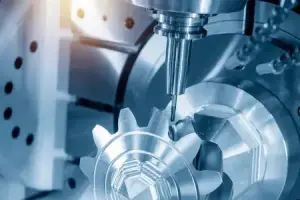
A CNC milled heat sink is produced by removing material from a solid block of aluminum or copper on a computer-controlled milling machine. Think of it as sculpting the exact fin pattern, base thickness, mounting holes, and any special pockets or steps directly from billet rather than forcing the design into a fixed extrusion profile.
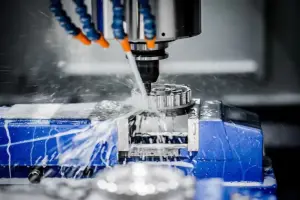
How the milling process works
A solid billet is fixtured on the machine.
Roughing tools rapidly remove bulk material to create the overall shape and fin channels.
Finishing tools cut the final fin thickness, spacing, and critical surfaces.
Secondary operations (drilling, tapping, face milling for flatness) complete the part before cleaning and finishing.
Common materials: 6061, 6063, and copper
|
Material |
Thermal Conductivity (approx.) |
Density |
Relative Cost |
Typical Use Case |
|
6061-T6 |
~167 W/m·K |
2.70 g/cm³ |
Low–medium |
Most custom aluminum heat sinks |
|
6063 |
~200 W/m·K |
2.70 g/cm³ |
Low–medium |
Better conductivity, good finish |
|
Copper (C110) |
~385–400 W/m·K |
8.9 g/cm³ |
High |
Highest performance, weight OK |
Aluminum dominates because it offers a strong balance of conductivity, weight, machinability, and cost. Copper is reserved for the most demanding heat-flux situations.
CNC vs Extruded vs Die-Cast vs Skived Heat Sinks
|
Process |
Precision & Flexibility |
Tooling Cost |
Typical MOQ |
Lead Time (first parts) |
Best For |
|
CNC Milling |
Highest |
Very low |
1+ |
Days to 2 weeks |
Custom geometry, prototypes, low–medium volume |
|
Extrusion |
Medium (constant profile) |
Medium |
Hundreds–thousands |
Weeks after die |
High volume, simple cross-sections |
|
Die Casting |
Medium |
High |
High |
Longer |
Complex shapes at very high volume |
|
Skived |
High fin aspect ratio |
Low–medium |
Medium |
Moderate |
Dense, thin fins, high performance |
CNC vs extruded heat sink is the most common decision. Extrusion wins on unit cost once annual volumes are high and the cross-section can be kept constant. CNC wins when you need non-uniform fins, integrated mounting features, tight flatness, rapid design changes, or quantities too low to justify a die. Skived fin heat sinks sit between the two for high-density fin arrays.
Where CNC Heat Sinks Make the Most Sense
LED drivers and high-power lighting modules that need compact, custom shapes
Communication equipment and base-station electronics
Industrial power supplies and motor drives
Commercial display and signage electronics
Laser systems and certain medical devices
In short, any application that combines moderate volume, unique geometry, the need for mounting holes or pockets in the same piece, or frequent design iteration benefits from a CNC machined aluminum heat sink.
Design Details That Decide Performance
Fin height, thickness, and spacing
Taller fins increase area but can become less effective if airflow is restricted. Very thin, tightly spaced fins look attractive on paper yet trap boundary layers and collect dust. Practical CNC designs balance height, thickness, and gap for the expected airflow (natural or forced).
Base thickness and flatness
The base must be thick enough to spread heat laterally before it reaches the fins, yet not so thick that it adds unnecessary thermal resistance or weight. Flatness on the mounting face is critical for good contact with the heat source; heat sink flatness tolerance is often specified in the 0.05–0.1 mm range or tighter depending on the interface.
Surface finish: anodizing vs bare
An anodized aluminum heat sink improves corrosion resistance and can slightly enhance emissivity for natural convection. Hard anodizing also increases surface durability. Bare aluminum or a thin conversion coating is sometimes preferred when maximum thermal conductivity at the interface is required and the environment is controlled.
Five items to give the factory before ordering:
3D model (STEP) and 2D drawing with critical dimensions
Material and temper
Target thermal performance or power dissipation
Flatness and surface-finish requirements
Quantity and any secondary operations (tapping, anodizing, etc.)
Case Study: Solving Overheating with a Custom CNC Heat Sink
An industrial electronics company was experiencing elevated field-failure rates on a power-control module. Laboratory testing showed the existing extruded heat sink could not keep junction temperatures within limits once the unit was installed in a real enclosure with restricted airflow.
The solution was a CNC milled heat sink designed around the actual board layout and available space. The new part incorporated optimized fin geometry, precise mounting holes, and a flatness-controlled base. Prototypes were machined quickly, thermal validation confirmed lower operating temperatures, and the design moved into production. Subsequent field data showed a clear reduction in thermal-related returns.
How to Choose a CNC Heat Sink Manufacturer
Evaluate potential partners on:
Machine capability and demonstrated tolerance control (especially flatness)
Material certification and traceability
Prototype speed and willingness to iterate
Inspection methods (CMM, optical, surface roughness)
Experience shipping internationally and handling documentation
A reliable custom CNC heat sink manufacturer or OEM heat sink manufacturer will also provide clear DFM feedback rather than simply quoting the drawing as-is. Industry recognition of consistent quality practices further supports buyer confidence when selecting a long-term CNC heat sink supplier.
What Affects the Price and Lead Time
Key cost and schedule drivers include:
Material choice (aluminum vs copper) and billet size
Machining time driven by fin density and overall volume of material removed
Tightness of flatness and dimensional tolerances
Surface treatment (anodizing, etc.)
Order quantity
Custom heat sink prototype work is typically quoted and delivered in days to a couple of weeks. Production pricing improves with volume, but CNC remains most competitive in the low-to-medium range where extrusion tooling cannot yet be justified. How much does a custom heat sink cost? depends on exactly these factors; transparent suppliers will break the quote into material, machining, finishing, and inspection.
FAQ
How much does a custom CNC heat sink cost?
It varies with size, complexity, material, and quantity. Prototypes are priced individually; production lots benefit from reduced setup amortization.
What is the minimum order quantity?
Most shops accept single prototypes and small batches. There is effectively no hard MOQ for CNC.
Aluminum or copper, which should I choose?
Aluminum (6061 or 6063) is the default for the majority of applications because of its excellent balance of conductivity, weight, and cost. Choose copper when heat flux is extremely high and weight is secondary.
Can you make a heat sink from my drawing?
Yes. Provide a STEP model and a drawing that highlights critical dimensions, flatness, and finish requirements.
How long does sampling take?
Typical prototype lead times range from a few days to two weeks depending on complexity and finishing.
What tolerance can CNC machining hold?
Dimensional tolerances of ±0.05 mm or better are routine; flatness on the mounting face is often held to 0.05–0.1 mm or tighter when specified.
Need a Heat Sink Quote?
If your current heat sink is limiting performance or you are starting a new design, send the 3D model, critical requirements, material preference, and target quantity. A clear quotation and practical manufacturing feedback will be returned promptly so you can evaluate a CNC milled heat sink against your thermal and commercial targets.