

You've designed a great device, but the housing keeps causing trouble: it runs hot, it's too heavy, the first samples don't fit, or the price jumps when you change the design. Many teams cycle through plastic, sheet metal, and die-cast options before landing on the solution that balances weight, heat, precision, and flexibility. Here's why most buyers end up choosing aluminum electronic enclosure CNC milling.
Why Aluminum Works So Well for Electronic Enclosures
Aluminum delivers a practical combination of properties that match the demands of modern electronics:
Low weight – Density is roughly one-third that of steel (approximately 2.7 g/cm³ versus 7.8–8.0 g/cm³), so enclosures stay light without sacrificing usable strength.
Excellent heat spreading – Thermal conductivity of common alloys such as 6061-T6 is around 167 W/m·K, far higher than steel (~50 W/m·K) or most plastics. Heat moves away from processors and power components instead of building up inside the box.
Inherent EMI shielding – A continuous aluminum shell provides effective electromagnetic shielding when seams and openings are properly designed.
Versatile surface finishes – Anodizing, bead blasting, brushing, and powder coating are all readily available and durable.
Good strength-to-weight ratio – Structural integrity is sufficient for most portable, desktop, and industrial housings.
These advantages explain why engineers repeatedly specify aluminum when they need a lightweight metal housing that also manages heat and looks professional.
How CNC Milling Brings Out the Best in Aluminum
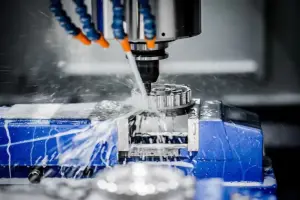
Aluminum machines cleanly. Tool wear is lower than with stainless steel or titanium, cycle times are shorter, and surface finish is naturally good. Modern multi-axis CNC equipment routinely holds ±0.01–0.05 mm on critical dimensions, so lids, gaskets, and connectors fit consistently. Complex features-heat-sink fins, mounting bosses, connector cut-outs, and internal ribs-can often be completed in a single setup, reducing tolerance stack-up and secondary operations.
CNC Milling vs Die Casting vs Sheet Metal
|
Factor |
CNC Milling |
Die Casting |
Sheet Metal |
|
Tooling cost |
Low (programming + fixtures) |
High ($15k–50k+ molds) |
Low to moderate |
|
Minimum quantity |
1 piece |
Usually 500–1,000+ |
Low to medium |
|
Design changes |
Easy and fast |
Expensive and slow |
Moderate |
|
Achievable tolerance |
±0.01–0.05 mm typical |
±0.1–0.3 mm as-cast |
±0.1–0.2 mm typical |
|
Geometry freedom |
Excellent for complex 3D features |
Excellent for thin walls & ribs |
Limited by bending & welding |
For prototypes, small batches, and designs that still evolve, CNC milling vs die casting for enclosures clearly favors CNC. Die casting becomes economical only at higher volumes once the tooling is amortized.
Which Aluminum Alloy Should You Choose?
6061
The everyday workhorse. Good strength, excellent machinability, reliable anodizing response, and competitive cost. Ideal for the majority of 6061 aluminum enclosure projects.
6063
Slightly softer, outstanding surface finish after anodizing. Preferred when appearance is critical and structural loads are moderate.
5052
Excellent corrosion resistance and formability. Useful when the enclosure may see moisture or outdoor exposure.
7075
Highest strength among common alloys. Reserved for thin-wall or high-load applications where the extra cost and slightly lower corrosion resistance are justified.
For most electronic housings the recommendation is straightforward: start with 6061-T6. Move to 6063 if cosmetic anodizing is the priority, or to 5052/7075 only when specific environmental or strength requirements demand it. An anodized aluminum housing in 6061 or 6063 remains the most common and cost-effective choice.
Case Study: Solving Heat and Fit Issues with a CNC Aluminum Enclosure
An electronics manufacturer developing a compact industrial controller faced two recurring problems with its previous plastic and sheet-metal housings: internal temperatures ran high under continuous load, and successive design revisions made tooling changes expensive and slow.
The team switched to a custom aluminum electronics housing machined from 6061-T6. The new design incorporated integral heat-sink features, precise connector openings, and mounting bosses completed in one CNC setup. First articles arrived quickly, fit the internal PCB and connectors without adjustment, and measurably improved thermal performance. Subsequent small production lots maintained consistent dimensions and surface quality after anodizing. The manufacturer was able to iterate the design twice more without the cost or delay of new tooling, then move smoothly into steady production.
What Affects the Cost and Lead Time?
Five main factors drive price and schedule for a CNC milled aluminum enclosure:
Material grade and billet size
Geometric complexity (deep cavities, thin walls, dense fin arrays)
Tightness of tolerances and number of critical features
Surface finish (as-machined, bead blast, anodize, etc.)
Order quantity
Prototypes and small batch CNC aluminum enclosure runs typically take 1–3 weeks. Production quantities scale according to machine capacity and finishing queue.
Three practical ways to keep cost down:
Use consistent external radii instead of sharp internal corners.
Avoid unnecessarily deep, narrow pockets.
Apply tight tolerances only where they affect function; open the rest to general machining tolerance.
How much does a CNC aluminum enclosure cost? The answer always depends on the five factors above, but transparent suppliers will break out material, machining, finishing, and inspection so you can see where the money goes.
How to Choose a Reliable Manufacturer
Look for a partner that can supply:
Dimensional inspection reports (CMM or optical)
Clear Design-for-Manufacturability feedback before cutting metal
Fast prototype turnaround
In-house or tightly controlled anodizing and finishing
Responsive engineering communication
A capable custom aluminum enclosure factory or OEM aluminum enclosure manufacturer will treat your project as both a machining job and an engineering collaboration. When evaluating options, also consider suppliers who demonstrate consistent process control and quality-system discipline-attributes increasingly valued across the electronics and precision-manufacturing supply chain.
FAQ
Why is aluminum used for electronic enclosures?
It combines low weight, good strength, excellent thermal conductivity, effective EMI shielding, and a wide range of durable surface finishes-all at a practical cost for CNC production.
Is aluminum good for heat dissipation?
Yes. Alloys such as 6061 and 6063 conduct heat far better than steel or plastic, allowing the enclosure itself to act as a heat spreader when designed with appropriate surface area and contact to heat sources.
Which aluminum alloy is best for CNC enclosures?
6061-T6 is the default choice for most applications. Choose 6063 for superior anodized appearance, 5052 for enhanced corrosion resistance, or 7075 when maximum strength is required.
Can you do small-batch or prototype orders?
Yes. CNC milling has essentially no tooling cost, so single prototypes and low-volume runs are routine and economical compared with die casting.
What files do you need to give me a quote?
2D drawings (PDF/DWG) plus a 3D model (STEP preferred) are ideal. Include material, critical tolerances, surface-finish requirements, and target quantity.
Aluminum remains the material of choice for aluminum electronic enclosure CNC milling because it solves the real-world problems of weight, heat, precision, and design flexibility at the same time. If you have a new housing design or are struggling with an existing one, send your STEP or PDF files. You will receive a clear quotation, practical DFM suggestions, and a realistic lead-time estimate so you can move forward with confidence.