
What Is Turn-Milling Compound Machining, Really?
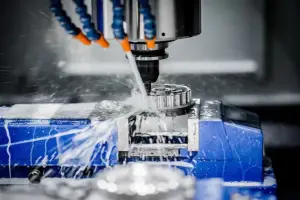
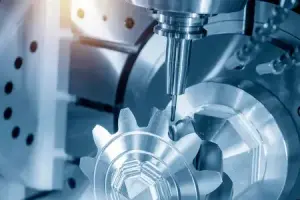
Turn-milling is not pure turning and it is not pure milling. It is an integrated process on one machine that combines workpiece rotation with live tooling under full CNC control. Live tools, C-axis positioning, and often a Y-axis or additional rotary axes let the machine handle both cylindrical surfaces and complex prismatic features without taking the part out of the chuck.
Traditional route: lathe → mill → secondary operations → inspection.
Turn-mill route: one chucking → complete turning + milling + drilling + tapping → inspection.
Because the part stays on the same datum, feature-to-feature relationships stay locked. This is where 5-Axis CNC Machining Parts deliver their real value. Simultaneous or positional 5-axis motion reaches undercuts, angled holes, and contoured surfaces that would otherwise need multiple fixtures. The result is tighter geometric accuracy and far less non-cutting time.
Why Automotive Parts Specifically Need This
Automotive components combine demands that sequential machining handles poorly.
Complex Geometries
Transmission shafts, steering knuckles, turbocharger housings, camshafts, and differential parts routinely mix turned diameters with milled flats, keyways, cross-holes, and contoured faces. One setup keeps coaxiality and angular relationships intact.
Tight Tolerances
Critical features often sit at ±0.01 mm or tighter. Every re-clamping introduces possible stack-up. Single-setup turn-milling keeps positional error low because every feature shares the same coordinate system.
Material Waste and Cost Control
Fewer fixtures, less handling, and lower scrap reduce total cost per part. Aluminum alloys, stainless steels, and titanium grades common in lightweight or performance applications machine cleanly when the tool paths stay continuous in one program.
Shop data and industry reports consistently show cycle-time reductions of 40–50 %, setup counts dropping from several operations to one or two, and measurable drops in cumulative error once multi-tasking platforms replace sequential machines.
One Setup vs. Five: The Real Cost and Time Difference
A typical complex automotive shaft or knuckle-style part looks like this:
Traditional process (often 4–6 setups): rough turn → finish turn → mill flats and keyways → drill and tap cross-holes → secondary mill or grind → final inspection. Each transfer needs new fixturing, re-indication, and carries misalignment risk.
Turn-mill compound process (1–2 setups): the part is chucked once; the machine completes all turning, milling, drilling, and tapping in a continuous program. Sub-spindle transfer, when available, finishes both ends with minimal operator intervention.
The advantage shows up clearly on CNC milled prototypes for automotive testing. Prototype lead times shrink because there is no queue between machines and no wait for secondary fixtures. Design teams iterate faster and move into production with higher confidence. The same single-setup logic later reduces WIP, labor, and floor space in volume runs.
How does turn-milling reduce production time? It collapses sequential operations into one continuous cycle and removes most inter-machine transfers. The savings come from eliminated setups, not from running the spindle faster.
|
Metric |
Traditional Multi-Machine Process |
Turn-Mill / 5-Axis Compound Process |
Typical Improvement |
|
Number of setups |
4–6 |
1–2 |
60–80 % reduction |
|
Lead time (complex part) |
Baseline |
40–50 % shorter |
Significant |
|
Cumulative positional error risk |
Higher (stack-up) |
Minimal (single datum) |
Major quality gain |
|
Fixture & handling cost |
High |
Low |
Clear savings |
|
Suitability for prototypes |
Slower iteration |
Fast validation |
Strong advantage |
Case Study - Clearing a Bottleneck on a Steering / Drive-Shaft Family
A typical automotive Tier supplier faced repeated delays on a complex steering-knuckle and drive-shaft family. The traditional routing used multiple machines and five or more setups. Critical bores and mounting faces showed cumulative tolerance problems; even moderate batches took weeks.
The parts moved onto a 5-axis capable turn-mill platform. All critical features were finished in one or two clampings. Results in similar transitions include setup time cut by roughly half, machining time reduced 15–40 %, overall lead time compressed 40–50 %, and first-pass yield improved because datum transfers disappeared. Process control followed ISO 9001 and IATF 16949 frameworks from prototype through volume.
The change was operational, not just technological.
How to Choose the Right 5-Axis CNC Machining Manufacturer / Factory
When you evaluate a 5-axis CNC machining manufacturer or 5-axis CNC machining factory, look for concrete evidence rather than claims:
Machine capability: true mill-turn or simultaneous 5-axis platforms with live tooling, adequate spindle power, and sufficient tool capacity.
Material experience: proven work with aluminum alloys, stainless steels, and titanium common in automotive programs.
Quality systems: CMM, in-process probing, and documented inspection plans that support ±0.01 mm (or tighter) requirements.
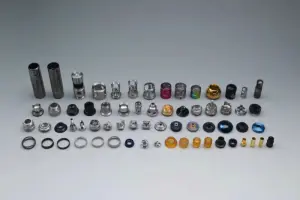
Prototype-to-production continuity: the ability to move from CNC milled prototypes into wholesale CNC milled automotive parts without re-qualifying the entire process.
Process transparency: willingness to discuss setup strategy, fixture philosophy, and how they control datums on your specific geometry.
A reliable precision automotive parts supplier China (or elsewhere) will show real part examples and talk through the trade-offs of multi-axis CNC machining vs traditional machining for your part family.
FAQ
Q: What's the difference between 5-axis milling and turn-milling compound machining?
A: 5-axis milling usually refers to a milling machine with two rotary axes that can reach complex surfaces in one or few setups. Turn-milling (or mill-turn) centers start from a turning platform and add milling capability through live tooling and extra axes. Many current machines combine both strengths, allowing full cylindrical and prismatic work in one environment. For rotational parts that also need milled features, the turn-mill approach is often the most efficient.
Q: Is turn-milling more expensive than traditional CNC machining?
A: Hourly rates can be higher, yet total part cost is frequently lower. Eliminated setups, fewer fixtures, lower scrap, and shorter lead times usually more than offset the rate difference-especially on complex parts or low-to-medium volumes where setup time dominates.
Q: Can turn-milling handle both prototyping and mass production?
A: Yes. The single-setup advantage is actually strongest at low volumes because setup overhead is spread over fewer pieces. The same process scales cleanly into higher volumes when the machine carries automation or dual spindles.
Q: What materials work best with 5-axis CNC machining parts?
A: Aluminum alloys (6061, 7075 and similar), stainless steels, alloy steels, and titanium are all routinely processed. Success depends more on correct tooling, speeds and feeds, and coolant strategy than on the number of axes.
Q: How do I find a reliable 5-axis CNC machining manufacturer?
A: Ask for evidence of relevant equipment, material experience, quality certifications (ISO 9001 / IATF 16949 for automotive), and sample process documentation. Specifically ask how the shop plans to reduce setups and control datums on your geometry. A transparent partner will discuss the real trade-offs rather than sell a generic capability list.