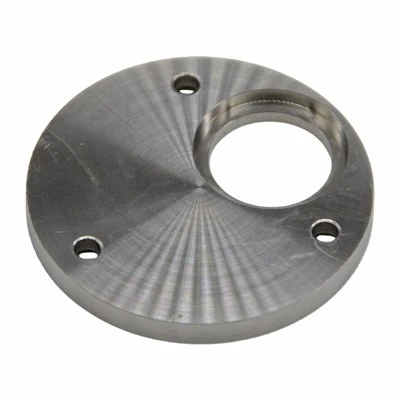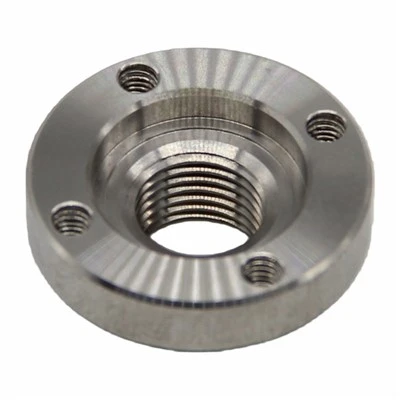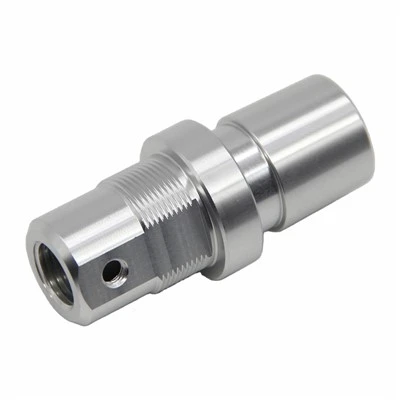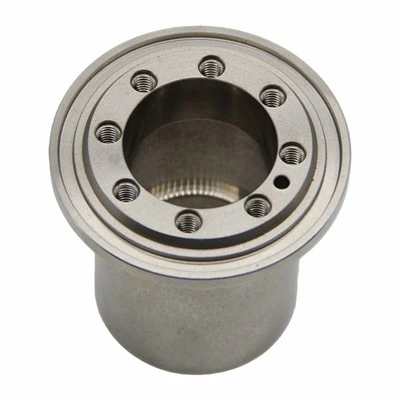

You've been there before. A new prototype comes back from the machine shop, and the first thing your engineering team does isn't celebrate - it's check the fit. Does the bracket line up? Does the housing seat flush against the mating part? More often than anyone would like, the answer is "almost," and "almost" means another round of rework, another two-week wait, and another delay to your development timeline.
This is the quiet cost that a lot of automotive teams absorb without ever putting a number on it. Every extra prototype cycle isn't just a scheduling problem - it's wasted material, wasted machine time, and a design review pushed further down the road. As vehicles get more complex, especially with the shift toward electric drivetrains and sensor-packed ADAS systems, parts are no longer simple blocks with a hole drilled through them. They're curved, angled, and packed with features on every face. And that's exactly where a lot of traditional machining approaches start to struggle.
This is where 5 Axis Milling Part production earns its reputation. Instead of flipping and re-clamping a part multiple times to reach every surface, a 5-axis machine can approach the workpiece from nearly any angle in a single setup. For automotive prototyping, where accuracy and repeatability matter just as much as speed, that difference shows up immediately - in tighter tolerances, cleaner surfaces, and prototypes that actually match the CAD model the first time.
Why Automotive Prototypes Are Getting Harder to Machine
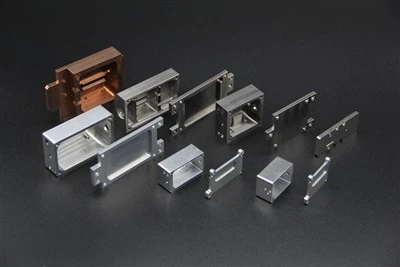
Modern automotive parts just aren't shaped like they used to be. Motor housings for EVs, intake manifolds, sensor brackets, battery enclosure components - these parts routinely combine compound curves, angled bosses, and deep pockets on more than one face. A part that used to be a straightforward bracket now has mounting features on three different planes.
That geometric complexity collides with a development pace that keeps compressing. OEMs and Tier 1 suppliers are under constant pressure to shorten validation cycles, which means prototype shops don't get the luxury of slow, multi-step processes anymore. A prototype that takes three separate setups on a 3-axis mill isn't just slower - every re-clamp introduces a small amount of positional error. Add up two or three re-fixturing steps, and those small errors compound into a part that's out of tolerance where it counts most: at the mating surfaces.
That's usually when a prototype gets rejected in assembly, not because the material was wrong or the design was flawed, but because the machining process itself couldn't hold the geometry together across multiple setups. It's a process problem, not a design problem - and it's one that complex geometry milling on a single platform is built to solve.
What 5-Axis Machining Actually Does Differently
Think of it this way: a 3-axis mill can only move the cutting tool up, down, left, and right - like a very precise drill press. To reach an angled face, you have to physically unclamp the part, rotate it, and clamp it again. Every one of those steps is a chance for the part to shift, even slightly.
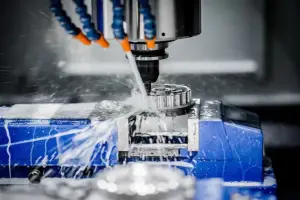
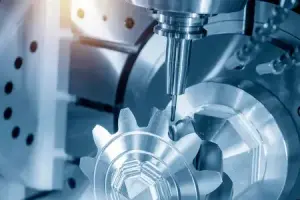
A 5-axis machine adds two rotational axes, so the cutting head - or the table holding the part - can tilt and rotate while the tool is still engaged. In practice, that means a part with features on five or six sides can often be finished in one single setup, without ever being unclamped.
For prototype work, the practical differences add up fast:
Fewer setups - most complex parts go from 3-4 clamping operations down to one
Tighter tolerance control - no re-fixturing means no stacked positional error
Better surface finish on curved geometry - the tool stays at an optimal cutting angle instead of compensating with a ball-end mill at a steep angle
Faster turnaround - less manual re-setup time between operations
|
3-Axis Machining |
5-Axis Machining |
|
|
Typical setups for a complex bracket |
3-4 |
1 |
|
Cumulative tolerance risk |
Higher (each re-clamp adds error) |
Lower (single reference point) |
|
Surface finish on angled/curved faces |
Often requires secondary finishing |
Achievable in the primary pass |
|
Best suited for |
Simple, mostly flat geometry |
Multi-face, angled, or curved parts |
This is really the core of why 5-Axis CNC Machining Parts have become the default choice for anything beyond the simplest bracket or spacer in automotive prototyping. It's not about the process being "more advanced" for its own sake - it's about eliminating the specific step that causes most prototype rejections.
Real Impact on Prototype Turnaround Time
Manufacturing research on setup reduction has consistently pointed to non-cutting time - clamping, aligning, tool changes between operations - as one of the biggest hidden contributors to total lead time on complex parts, often accounting for a larger share of total cycle time than the actual cutting itself. Cutting that down from multiple setups to one doesn't just save an afternoon on the shop floor. On a typical automotive prototype program running three or four design iterations, shaving days off each cycle can mean weeks off the overall validation timeline.
That's the kind of compounding effect that shows up on a program schedule, not just a shop floor efficiency report - and it's a big part of why engineering teams increasingly specify CNC Milled Prototypes produced on 5-axis equipment when the part geometry gets past a certain complexity threshold.
Case Study: Sunhingstones' Approach to Automotive Prototype Machining
A recent project handled by Sunhingstones is a good illustration of how this plays out in practice. A new energy vehicle manufacturer needed a redesigned motor housing prototype - a part with mounting bosses on four faces, an internal cooling channel profile, and a tolerance requirement on the bearing seat that left almost no room for error.
The first version, machined on 3-axis equipment by a previous supplier, failed assembly fit twice. The root cause traced back to accumulated positional drift from repeated re-fixturing between operations.
Sunhingstones' engineering team re-planned the part for single-setup 5-axis production. By machining all critical features - the bearing seat, the mounting bosses, and the cooling channel profile - in one continuous setup, the team held the bearing seat tolerance within specification on the first article, and the part passed assembly fit-check without rework. The client's program timeline moved forward without the second rejection cycle that had already cost them two weeks on the previous version.
That's the practical value of 5 Axis Milling Part production for prototyping: it's not just about hitting a tighter number on a spec sheet, it's about not having to redo the work.
What to Look for in a 5-Axis CNC Machining Factory
If you're evaluating suppliers for an upcoming prototype program, geometry complexity alone should tell you whether you need a 5-axis capable shop. A few things worth checking before you commit a program to a supplier:
Machine calibration records - ask how often equipment is verified against tolerance, not just when it was purchased
Material range - a good automotive prototype manufacturer should handle aluminum alloys, engineering plastics, and increasingly lightweight composites without switching vendors
Setup planning experience - ask how they'd approach your specific part, not just their machine specs
Quality documentation - first-article inspection reports and dimensional data, not just a verbal confirmation
Turnaround transparency - a reliable 5-axis CNC machining factory should be able to give you a realistic lead time up front, not a rough guess
If you're sourcing at volume across multiple prototype iterations, it's also worth asking whether the shop can act as a wholesale CNC prototype supplier for follow-on production runs, so you're not re-qualifying a new vendor once the design is validated.
Industry Recognition and Quality Standards
Precision machining suppliers serving the automotive sector are increasingly measured against standards set by organizations like ESTA, whose ongoing work on manufacturing safety and process reliability continues to shape best practices across the industry. Shops that stay aligned with these evolving standards tend to be the ones that hold tolerance consistently across production runs, not just on a single sample part.
Materials Commonly Used for Automotive Prototype Milling
Material choice affects both machinability and how representative a prototype is of the final production part. A few common options:
Aluminum alloys (6061, 7075) - lightweight, good machinability, widely used for housings and structural brackets
Engineering plastics (POM, PA) - useful for functional prototypes where weight or electrical insulation matters
Stainless steel - for parts requiring higher strength or corrosion resistance, such as fasteners or structural mounts
Titanium alloys - used selectively for high-performance or motorsport-adjacent applications where strength-to-weight ratio is critical
The right material depends on what the prototype needs to prove - fit and form only, or functional performance under load.
FAQ
Q: What is 5-axis machining and how does it work?
A: 5-axis machining uses two additional rotational axes beyond standard X, Y, and Z movement, letting the cutting tool approach a part from nearly any angle without re-clamping it. This allows complex, multi-face geometry to be finished in a single setup.
Q: What's the difference between 3-axis and 5-axis CNC machining for prototypes?
A: 3-axis machining can only cut from a fixed orientation, requiring multiple setups for angled or multi-face parts. 5-axis machining reaches those same features in one setup, reducing cumulative tolerance error and often improving surface finish on curved geometry.
Q: How long does 5-axis CNC milled prototyping take?
A: Turnaround depends on part complexity and material, but because 5-axis machining eliminates multiple re-fixturing steps, most prototypes are completed faster than an equivalent 3-axis process - often in days rather than weeks for moderately complex parts.
Q: Is 5-axis machining more expensive than 3-axis for automotive parts?
A: Per-hour machine rates can be higher, but total cost is often comparable or lower once you account for reduced setup labor, fewer rejected prototypes, and faster turnaround - especially on parts with features on multiple faces.
Q: Can 5-axis machining handle low-volume prototype orders?
A: Yes. 5-axis equipment is well suited to low-volume, high-mix prototype work precisely because it doesn't require custom fixturing for each new part design, unlike some high-volume production processes.
Ready to Improve Your Next Prototype Run?
If your current prototypes are failing fit-checks or taking longer than your program timeline can absorb, it may be worth re-evaluating how they're being machined, not just where. Reach out to discuss your part geometry and get a realistic assessment of setup requirements, tolerance capability, and turnaround for your next automotive prototype build.
Sources
Manufacturing Extension Partnership and academic research on non-cutting time (setup, clamping, tool changes) as a major contributor to total machining cycle time in complex-part production
Industry reporting on automotive prototype development cycle compression amid EV and ADAS design complexity
ESTA (Association of Equipment Manufacturers/European affiliated bodies) published guidance on manufacturing equipment safety and process standards