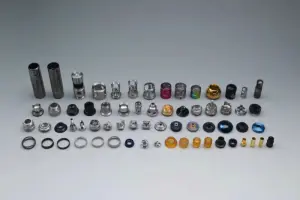

Machining aluminum alloys via CNC requires comprehensive management across material properties, parameter settings, tool selection, deformation control, and surface treatment. The specific considerations are outlined below:
Material Properties and Pre-Processing
Confirm the alloy grade and temper condition: Different aluminum alloy grades (such as 6061 and 7075) vary significantly in hardness, ductility, and thermal conductivity, which directly affects cutting parameter selection. It's important to determine whether the material has undergone heat treatment (e.g., T6 temper) - untreated material carries a higher risk of machining distortion. Notably, 2xxx series alloys (such as 2024), while offering higher strength, have relatively poor corrosion resistance; parts used in humid or corrosive environments require additional surface protection. 5xxx series alloys (such as 5052) offer excellent weldability and are commonly used for structural components and housings, but their machinability is somewhat inferior to 6061, with a greater tendency toward chip adhesion - this calls for adjusting the tool's rake angle and coolant concentration accordingly.
Internal stress management: Large aluminum stock may contain uneven internal stresses that need to be relieved through natural aging (rest/settling) or artificial aging (heat treatment) to reduce machining distortion. For parts with extremely tight precision requirements (such as optical instrument structural components or aerospace connectors), it's advisable to add a stress-relief annealing step between roughing and finishing - typically heating the workpiece to 150–200°C, holding for 1–2 hours, then cooling slowly. This further reduces dimensional drift caused by stress release during subsequent finishing.
Fixturing optimization: Use dedicated fixtures or vacuum suction to secure the blank, avoiding excessive clamping force that could deform the workpiece - especially for thin-walled parts, which require auxiliary support structures. For irregularly shaped or highly contoured parts, consider using low-melting-point wax or plaster to encapsulate the workpiece for support, then heating to melt and remove it after machining. This maximizes positioning accuracy while minimizing localized deformation from clamping stress.

Cutting Parameter Settings
Cutting speed control: Aluminum alloys have high thermal conductivity, allowing for cutting speeds typically 2–3 times higher than steel - but excessive speed can accelerate tool wear or cause chip adhesion. For example, when roughing 6061 aluminum, cutting speed can be set to 800–1200 m/min, dropping to 600–800 m/min for finishing. Note that actual cutting speed should also be adjusted in consideration of spindle power, tool overhang length, and workpiece rigidity - blindly pursuing higher RPM can instead trigger chatter and compromise surface quality.
Feed rate balance: Too low a feed rate causes friction and heat buildup between tool and workpiece; too high a rate can lead to poor chip evacuation or a rough surface. Recommended feed rate ranges: 0.1–0.3 mm/tooth for roughing, 0.05–0.15 mm/tooth for finishing. In practice, it's advisable to start at the midpoint of the recommended range, then fine-tune based on cutting sound, chip shape (ideally short spiral or C-shaped chips), and surface finish - avoiding needle-like fine chips that wrap around the tool.
Depth-of-cut layering: Machine in layers according to tool rigidity - for roughing, a single depth of cut of 50%–70% of the tool diameter is recommended; for finishing, limit the depth of cut to 0.1–0.5 mm to reduce distortion caused by cutting forces. For deep-cavity or deep-hole features, use staged plunging with intermittent retraction for chip evacuation to prevent chip buildup that could break the tool or cause bore diameter deviations.
Tool Selection and Cooling Measures
Tool geometry: Use sharp tooling - increasing the rake angle to 15°–25° and the relief angle to 8°–12° improves chip evacuation and reduces cutting forces. Cutting-edge sharpness is especially critical for aluminum machining; a dull or worn tool readily produces built-up edge (BUE), which affects surface roughness and dimensional consistency. It's advisable to establish a tool-life monitoring system for regular replacement or regrinding.
Tool material selection: Carbide tools (such as K10, K20 grades) suit most aluminum alloy machining; PCD (polycrystalline diamond)-coated tools are suitable for high-precision, long-life applications, though at higher cost. For batch production where precision requirements aren't extreme, high-speed steel (HSS) tooling can serve as a cost-effective alternative - though its wear resistance and speed ceiling are both lower than carbide, requiring correspondingly reduced cutting parameters.
Cooling method optimization:
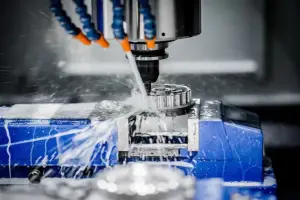
Flood cooling: suited to roughing, directly flushing the cutting zone for rapid heat dissipation.
Mist cooling: used during finishing, reducing coolant splatter while improving lubrication.
Coolant selection: water-soluble coolants with extreme-pressure additives effectively reduce friction; avoid coolants containing chlorine or sulfur to prevent corrosion. Additionally, for ultra-precision machining or certain optical/medical device components, minimum quantity lubrication (MQL) or dry cutting may be used to reduce coolant residue that could affect subsequent cleaning and surface treatment steps.
Precision Control and Deformation Management
Symmetric machining strategy: For thin-walled or complex structural parts, use symmetric cutting paths to balance stress distribution and reduce deformation caused by one-sided loading.
Machining sequence planning: Rough machining first to release most internal stress, followed by semi-finishing with a 0.2–0.5 mm allowance, then finishing to achieve final dimensional accuracy. For especially complex parts, a four-stage "rough – semi-finish – age – finish" process can be adopted, inserting a brief stress-relief step between semi-finishing and finishing to further compress the final deformation.
Ambient temperature control: Maintain stable shop temperature (within ±2°C) during precision machining to avoid dimensional deviation from thermal expansion and contraction. Aluminum alloy's coefficient of thermal expansion is roughly twice that of steel, so investing in constant-temperature, constant-humidity environmental control can significantly improve yield rates in high-precision shops - particularly for batch production of precision-fit components.
In-process measurement compensation: Use laser interferometers or contact probes to monitor machining dimensions in real time, with the CNC system automatically correcting the tool path. For long-running production lines, statistical process control (SPC) methods can also be introduced to track trends in key dimensions, providing early warning of systematic deviations such as tool wear or thermal drift.
Surface Treatment and Cleaning Requirements
Thorough cleaning: Immediately after machining, remove residual coolant and aluminum chips using high-pressure air guns or ultrasonic cleaning equipment to prevent oxidation or corrosion.
Allowances for surface treatment:
Anodizing: requires a 0.05–0.1 mm allowance, since the oxide layer thickness is approximately 5–20 μm.
Bead/sand blasting: requires a 0.1–0.2 mm allowance to avoid exceeding surface roughness tolerances. Beyond these two common treatments, hard anodizing produces an oxide layer of 30–60 μm or more, requiring a correspondingly larger allowance - it's advisable to confirm exact figures with the surface treatment vendor in advance to avoid final dimensions falling out of tolerance and requiring rework.
Rust prevention: After cleaning, apply anti-rust oil or use vapor corrosion inhibitor (VCI) bags for packaging, especially for parts intended for long-term storage. For products shipped by sea for export, it's advisable to also include desiccant inside the packaging and use vacuum or moisture-proof packaging, to guard against significant humidity fluctuations during long-distance transport and reduce the risk of oxidation or rust en route.
Summary
Aluminum alloy CNC machining requires dynamically adjusting process parameters based on material properties - relieving stress through pre-processing, optimizing tooling and cooling strategies, controlling machining sequence and ambient temperature, and strictly managing cleaning and surface treatment workflows. A systematic approach can significantly improve machining efficiency and product quality while reducing scrap rates. In practice, companies should also establish standardized process documentation and tooling management records, continuously optimize parameter combinations based on specific equipment performance and product precision requirements, and strengthen operator skills training - allowing process expertise to accumulate and be passed on, thereby ensuring quality stability while continuously improving overall machining efficiency and cost competitiveness.