How a traditional manifold is made - and where it falls short
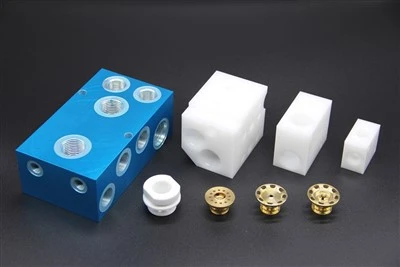
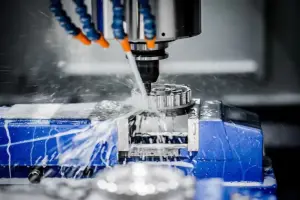
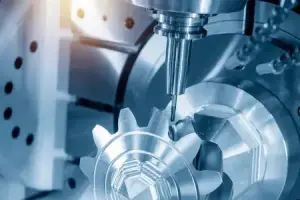
Most hydraulic or fluid manifolds start as a solid billet of aluminum or steel. A CNC machine drills straight holes from different faces. Where two holes need to meet, the designer adds a cross-drilled intersection. Leftover openings get plugged with set screws or welded plugs. Ports are threaded and the block is finished.
This approach works when the flow paths stay simple and volumes are high. The limitations appear quickly, though:
Every internal turn is a sharp 90-degree corner.
Blind holes and trapped volumes collect dirt or residual fluid.
Each plug and each external fitting becomes a potential leak point.
Material that is not needed for strength stays in the part, so weight climbs.
Changing the flow path means new programming or even a new billet.
When the circuit needs more than a handful of ports, or when pressure drop and cleanliness matter, the traditional CNC drilled manifold starts to feel like a compromise. That is the moment many teams begin looking for a CNC drilled manifold alternative and start evaluating hydraulic manifold design options that free the internal geometry.
How a metal 3D printed manifold works
A 3D printed manifold is built layer by layer from metal powder using laser powder-bed fusion (LPBF / SLM). The machine melts only the material that is required, so internal channels can follow almost any path the designer wants-smooth curves, changing cross-sections, conformal routes that hug heat sources, or branching networks that would be impossible to drill.
Because the part grows as one piece, valve seats, sensor bosses, mounting features, and tube connections can be integrated directly into the body. The number of separate components drops sharply. External seals and welded joints largely disappear. The result is a lighter, cleaner, and often more compact metal 3D printed manifold.
Common materials include 316L stainless steel for corrosion resistance, AlSi10Mg for thermal performance and low weight, Ti6Al4V for high strength-to-weight needs, and Inconel 718 when temperature or aggressive media are involved. After the build the part receives heat treatment, support removal, CNC finishing of sealing faces and threads, and pressure or leak testing. From approved STEP file to shippable prototype the typical window is 7–15 working days.
Side-by-side comparison
|
Aspect |
CNC Drilled Manifold |
3D Printed Manifold |
|
Internal flow freedom |
Straight holes + 90° intersections only |
Freeform curves, variable sections, conformal paths |
|
Number of parts |
Often 8–15 (block + fittings + plugs) |
Usually 1 integrated component |
|
Typical weight |
Higher (excess material remains) |
20–40% lower when topology-optimized |
|
Leak points |
Multiple plugs, fittings, and joints |
Only external sealing faces |
|
Lead time (prototype) |
2–6 weeks (programming + machining) |
7–15 working days |
|
Unit cost – low volume |
High (setup + scrap risk) |
Competitive once design is fixed |
|
Unit cost – high volume |
Lower (amortized tooling and fixtures) |
Higher unless design is highly optimized |
|
Best volume range |
Medium to high |
Prototype to low / medium |
|
Design change cost |
Expensive (new program or billet) |
Relatively low (new print) |
The numbers make the trade-offs plain. A 3D printed manifold leads on geometric freedom, part count, weight, and speed for prototypes or small batches. A CNC drilled manifold still holds the edge when the geometry is simple and annual volume is high enough to absorb setup costs.
Quick reference specifications for metal additive manifolds
Typical build envelope: up to 250 × 250 × 300 mm
Dimensional tolerance after CNC finishing: ±0.1–0.2 mm on critical features
Internal channel roughness: Ra 6–15 µm as-built
Minimum wall thickness: 0.8–1.0 mm (geometry-dependent)
Working pressure: material- and design-dependent; routinely validated to several hundred bar
When CNC is still the better choice
Honesty matters more than forcing every job into additive. CNC remains the smarter route in several everyday situations:
Annual volumes run into the hundreds or thousands and the flow paths stay simple.
The circuit needs only a few straight intersecting holes.
Unit cost is the dominant factor and the design is already frozen.
The material or size exceeds practical LPBF build envelopes.
Existing fixtures, tooling, and qualified processes are already in place and change would trigger costly requalification.
In those cases a well-executed CNC drilled manifold is still the most economical and reliable solution. We regularly tell customers when a 3D printed manifold is not the right answer.
Case study - industrial automation fluid circuit
A mid-sized automation equipment manufacturer came to us with an 11-piece hydraulic manifold assembly. The original design used a CNC-drilled aluminum block plus ten separate fittings and plugs. The assembly showed leaks at two interfaces during final test, weighed more than the space allocation allowed, and required nearly four weeks to machine and assemble each time a design change was needed.
The circuit was redesigned as a single metal 3D printed manifold in 316L. Internal channels were smoothed with gradual transitions. Six external leak points disappeared. Topology optimization removed unnecessary material while keeping required stiffness. The finished part came in approximately 30% lighter than the original assembly. Functional prototypes shipped in 11 working days. The customer's own pressure and cycle testing confirmed performance under the same duty cycle. Small-batch production continued on the same additive process without new tooling.
Results like these are typical when the geometry is complex and the volume stays in the prototype-to-low-hundreds range. They are also why teams looking for a reliable metal 3D printed manifold manufacturer or custom manifold supplier often start with a direct comparison quote.
How to decide in 5 questions
How complex are the internal flow paths? If you need curves, variable diameters, or conformal routes, a 3D printed manifold is almost always the stronger option.
What is the expected annual volume? Under roughly 50–100 pieces, additive usually wins on total cost and speed. Above several hundred, CNC often becomes cheaper.
How important is weight or envelope size? If every gram or every millimeter counts, additive's ability to remove excess material is hard to match.
How often will the design change? Frequent iterations favor the 3D printed manifold because there is no tooling to scrap.
Are leak points and cleanliness critical? Fewer joints almost always improve reliability and reduce residual volume in hydraulic manifold design.
Answer those five questions honestly and the choice between a CNC drilled manifold and a 3D printed manifold usually becomes clear.
FAQ
Q: Are 3D printed manifolds strong enough for high-pressure service?
A: Yes. When wall thickness, material, and post-processing are specified correctly, fully dense LPBF parts in 316L or Inconel routinely pass proof and burst testing at several hundred bar. The limiting factor is design, not the process itself.
Q: How much does a 3D printed manifold cost?
A: Prototype pricing typically ranges from a few hundred to a few thousand dollars. The main variables are overall size, material choice, internal complexity, and the amount of CNC finishing required on sealing faces and threads. Low-volume series stay competitive because there is no tooling amortization. For high-volume simple geometries, CNC is usually less expensive per piece. The fastest way to know is to send the STEP file for a side-by-side quote.
Q: Is a 3D printed manifold a good CNC drilled manifold alternative?
A: For complex internal geometry, weight-critical applications, or low-to-medium volumes, it is often the better alternative. For simple high-volume blocks, CNC still holds the cost advantage.
Next step
If you are evaluating a 3D printed manifold for an upcoming project, the practical next step is a design review and quotation. Upload your current drawing or STEP file and we will return a clear comparison of geometry feasibility, estimated weight saving, lead time, and cost against a traditional CNC approach.
For full technical detail on materials, process capability, and quality controls, visit our product page on Metal 3D Printed Manifolds.