
Core Advantages
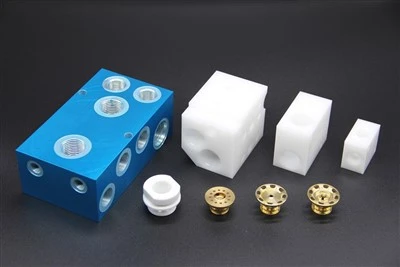
Delrin (POM-H, acetal homopolymer) is one of the most balanced engineering plastics, offering strong dimensional stability, self-lubrication, and machinability. It is a preferred choice for applications requiring tight tolerances, low friction, and long-term reliability.
Key advantages of Delrin:
Excellent dimensional stability:
very low moisture absorption (<0.25% at 24h), maintaining precision in varying humidity - significantly better than nylon.
High mechanical strength & rigidity:
good tensile strength and flexural modulus, well-suited to load-bearing precision components.
Strong self-lubrication:
low coefficient of friction (~0.15–0.20 against steel) for smooth operation without added lubricants.
Food & medical compliance options:
FDA- and EU 10/2011-compliant grades available for direct food contact and medical-device applications.
Good electrical insulation:
high dielectric strength, suitable for many electrical and electronic components.
Excellent machinability:
stable cutting performance enables fine surface finish and complex geometries with tight tolerances.
Material Properties
Delrin (acetal homopolymer) delivers a strong combination of mechanical, thermal, and chemical properties for precision machined parts.
Technical Specifications
|
Property |
Delrin (POM-H) Typical Value |
Notes |
|
Density |
1.41 g/cm³ |
Lightweight |
|
Tensile Strength |
62–70 MPa |
Yield |
|
Flexural Modulus |
2,800–3,200 MPa |
High rigidity |
|
Rockwell Hardness |
M85–M94 |
Good wear resistance |
|
Heat Deflection Temp (1.82 MPa, ISO 75) |
~110 °C |
Higher at lower load (~160 °C at 0.45 MPa) |
|
Continuous Service Temperature |
−40 to ~90 °C |
Short-term excursions to ~120 °C |
|
Water Absorption (24 h) |
<0.25% |
Very low - excellent stability |
|
Dynamic Friction Coefficient (vs. steel) |
0.15–0.20 |
Strong self-lubrication |
Values are typical for unfilled POM-H. Actual values vary with supplier, grade, and test method; we provide datasheets on request.
Delrin vs Competing Materials
|
Performance |
Delrin (POM-H) |
Nylon 66 |
Acetal Copolymer (POM-C) |
PTFE |
|
Dimensional stability |
Excellent |
Fair |
Good |
Excellent |
|
Self-lubrication |
Excellent |
Fair |
Very good |
Best in class |
|
Mechanical strength |
Excellent |
Excellent |
Good |
Poor |
|
Food-contact options |
Yes |
Limited |
Yes |
Yes |
|
Machining precision |
Excellent |
Fair |
Good |
Difficult |
Machining Capabilities
Comprehensive CNC machining services for Delrin, supporting precision custom parts from prototyping through production.
Processes:
5-axis CNC milling, CNC turning, drilling, tapping, and internal threading
Size capacity:
up to Ø300 mm diameter and 800 mm length (larger sizes on request)
Equipment:
high-rigidity 5-axis machining centers and precision CNC lathes
Tolerances & Surface Finish
Tolerance capability: general ±0.025–0.05 mm; ±0.01 mm achievable on critical dimensions; ±0.005 mm on selected features with grinding/lapping
Surface roughness: Ra 0.4–1.6 μm, with options for mirror polish or matte finish
Inspection: 100% CMM inspection with full dimensional reports
Plastic parts typically follow looser general tolerances than metals due to thermal expansion; we confirm achievable tolerances against ISO 20457 and your drawing requirements during DFM.

Supported Industries & Applications
Medical devices:
surgical instrument handles, precision positioning components, drug-delivery parts
01
Food-processing equipment:
conveyor components, valves, food-contact structures
02
Electronics & electrical:
insulating brackets, connectors, switch housings
03
Automotive:
fuel-system components, sensor housings, sliding mechanisms
04
Semiconductor:
cleanroom-compatible anti-static structural parts
05
Common Machining Challenges & Solutions
Delrin machines well, but presents specific challenges that benefit from experienced handling.
Challenge 1 - Thermal deformation during high-speed cutting
Delrin has relatively low thermal conductivity, making it prone to localized heating and distortion.
Solution: compressed-air cooling combined with micro-lubrication, plus optimized feed rates and depths of cut to control machining temperature.
Challenge 2 - Burr formation on thin walls
Thin-walled features tend to produce burrs that affect assembly and surface quality.
Solution: sharp, high-quality coated tools and dedicated deburring/polishing processes for clean, smooth surfaces.
Challenge 3 - Maintaining tight tolerances on long parts
Long components are susceptible to internal stress and bending.
Solution: pre-annealing of stock material combined with symmetrical, segmented machining strategies to control straightness and roundness.
Challenge 4 - Thread quality and strength
Delrin threads can suffer from poor profile or low strength if cut incorrectly.
Solution: specialized taps for plastics, optimized tapping parameters, and appropriate fit-class recommendations during DFM.
Why Choose Us
Specialized Delrin machining experience across medical, food-contact, and industrial programs
ISO 9001:2015 certified quality management system; FDA / RoHS documentation available on request
Rapid prototyping: samples typically delivered in 5–7 working days
Free DFM (Design for Manufacturability) review to reduce cost and improve quality
100% CMM inspection with complete dimensional reports
Flexible MOQ - from 1-piece prototypes to thousands for production
FAQ
Hot Tags: delrin machined parts, China delrin machined parts manufacturers, suppliers, factory, Aerospace Milled Parts, Brass CNC Milling, CNC Milled Heat Sinks, On demand CNC Machining, Plastic CNC Milling, Stainless Steel Milling Parts