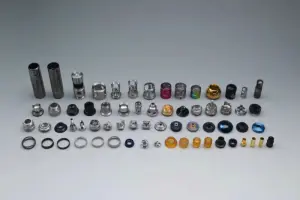

A German buyer took delivery of 500 POM gears in March. Every critical dimension on the inspection report sat inside tolerance, measured at the machine before the crate closed. Six weeks later three assembly lines stopped, because the bores had closed by 0.09 mm and the shafts would not go in. That gap between the report and your bench is the most expensive thing in cnc plastic machining.
The Report And Your Bench Are Two Different Measurements
A plastic part is clamped when the shop measures it, and warm from cutting. Release the vise, let it cool, ship it across an ocean, and the same feature will not read the same. No datasheet covers this part of cnc plastic machining.
Movement has more to do with material than machine. Aluminum expands about 23 microns per meter per degree Celsius. Polycarbonate sits near 65. POM runs 100 to 130. Machine a 100 mm POM part at 30 degrees and inspect it at 20, and you have roughly 0.1 mm of drift before anyone makes a mistake. Put a 0.05 mm tolerance on that feature and you have written something the part cannot hold in two rooms, whoever you buy from.
Most arguments about cnc plastic machining are not quality failures. They are two people holding calipers in two buildings at two temperatures, with one drawing that never said which one counts.
Humidity Moves Nylon More Than Any Machine Error
PA6 and PA66 pull moisture out of the air, and a wet part is a bigger part. Depending on grade and climate, a nylon component can swell by half a percent or more after machining. On a 40 mm bore that is 0.2 to 0.4 mm, which is not a tolerance problem, it is a different part.
A customer in the US found this with PA66 guide bushings. The first batch was inspected dry in winter and flown over. Perfect fit. The second batch, same drawing, same shop, went by sea in summer, arrived oversize and jammed in the fixture. Not one cutting parameter had changed.
If the drawing calls for nylon, decide before the quote whether the part is measured dry, conditioned, or wet. Either the shop anneals and conditions the parts and you accept the conditioned number, or you accept the dry number and you own the swell. Any guide to cnc plastic machining that skips moisture is telling half the story.
Stress Relief Is Where cnc plastic machining Earns Its Price
Every plastic part carries stress, some of it baked into the sheet at extrusion, some from the machining. Cut a pocket into stressed stock and the material relaxes into the space you just opened. The part measures beautifully while it is clamped, then bows when the pressure comes off. Stress is where cnc plastic machining quietly diverges from metal work.
An Israeli customer scrapped 1,200 polycarbonate lens holders, around 6,000 dollars including vapor polishing, because the flange bowed 0.2 mm once the vise was released. Nobody had checked the stock, and the quote had no annealing step in it.
Stock selection is one lever. Cast or annealed sheet costs more because somebody already did the relief. Process is the other, and it is the one buyers forget to pay for. Rough machine, anneal, finish. Our CNC milling service runs that sequence on thin-wall work, because a single finishing pass will not hold a flat flange on a 3 mm wall.
If a shop quotes a thin-wall plastic part with no annealing step and one setup, ask what they expect the wall to do.
Measure It In The Right Room, With The Right Tool, At The Right Time
Settle the conditions before the first chip, not after the first rejection. The protocol for cnc plastic machining is short and almost nobody writes it down.
Temperature comes first in practice. A controlled room at 20 degrees Celsius plus or minus two, with a couple of hours of settling, is the working standard for tight work. If neither side has one, widen the tolerance instead of arguing in six weeks.
Then the instrument and the clock. Plastic is soft, and a caliper jaw will flatten a thin wall enough to flatter the reading, so under about 2 mm of wall use non-contact measurement. And a part is not stable the moment the spindle stops. Twenty four hours of settling is a sensible floor for POM and nylon, longer if the part ran hot.
What The Drawing Never Says About cnc plastic machining
Drawings carry geometry. They rarely carry the conditions that decide whether the geometry counts, and that is the commercial side of cnc plastic machining nobody puts in writing.
Spell out the measurement temperature and the settling window. Say whether functional dimensions are checked dry or conditioned. State who owns stress relief, because if it is not quoted it is not happening. Fix the sampling plan and the AQL, and decide up front whether you want a first article report and material certificates with the batch.
Four extra lines on a purchase order remove most of the arguments that follow a container. Our CNC machining services pages list the tolerances we hold on each plastic, and the plastic CNC milling section covers wall thickness limits in detail.
Quick Answers On Measuring Plastic Parts
What tolerance can cnc plastic machining actually hold?
On rigid engineering plastics such as POM, PC and PEEK, cnc plastic machining holds plus or minus 0.05 mm on critical features, as long as the measurement conditions are agreed in advance. On nylon and other hygroscopic grades, expect a looser number tied to the moisture content at the moment of measurement.
Should plastic parts be inspected hot off the machine?
No. Let them settle. Twenty four hours at room temperature is a reasonable floor for POM and nylon, and conditioned nylon needs longer.
Can I measure a plastic part with a caliper?
On thick sections with loose tolerances, yes. On thin walls and tight features the jaw pressure itself changes the reading, so use non-contact or light-touch measurement.
Why did my nylon parts change size between two shipments?
Moisture. A dry part inspected in winter and a wet part arriving in summer give you two different numbers off the same drawing and the same machine.
If your last plastic order arrived with a report that no longer matched the parts, send us the drawing together with the inspection conditions you actually use. We will tell you which dimensions are realistic in your material, which ones belong on a coordinate machine, and where the process needs an annealing step. If you need cnc plastic machining that still measures the same after the trip, that conversation belongs before the order, not after it.