
Core Capability
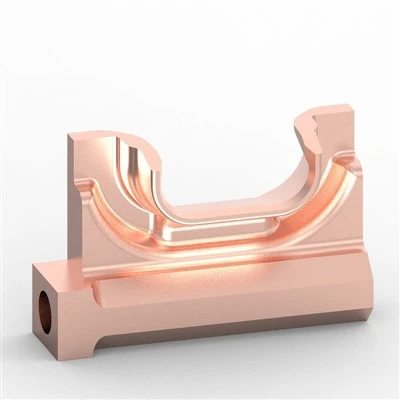
Our facility runs industrial laser powder-bed fusion platforms operated by a team of senior materials engineers. We don't just print parts - we optimize your geometry for the additive process and qualify it through to final inspection.
Technologies:
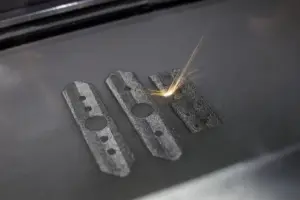
Laser Powder Bed Fusion - SLM (Selective Laser Melting) and DMLS (Direct Metal Laser Sintering).
Maximum Build Envelope:
Up to 500 × 500 × 600 mm on our large-format platforms (machine-dependent), supporting large-scale part consolidation.
Precision & Surface Quality:
As-printed dimensional accuracy typically ±0.1–0.2 mm, with tighter tolerances down to ±0.02–0.05 mm achievable on critical features after CNC finishing. Near-net-shape geometry minimizes downstream machining.
Post-Processing - full in-house suite:
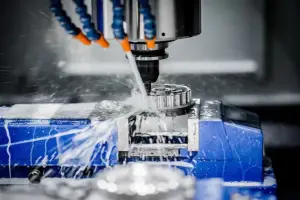
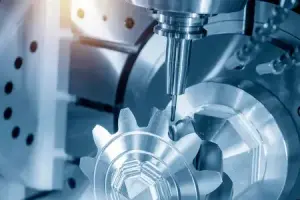
CNC Machining: tight-tolerance threads, bores, and mating surfaces.
Heat Treatment: stress relief, solution / aging, and Hot Isostatic Pressing (HIP) to close residual porosity and improve fatigue performance.
Surface Finishing: bead blasting, electropolishing, and mirror-finish grinding to specification.
Materials
All powders are sourced from certified suppliers with documented chemical composition and traceability. Heat-treatment routes are matched to the alloy and the application.
|
Material Group |
Common Alloys |
Key Properties |
Typical Applications |
|
Titanium |
Ti-6Al-4V (Grade 5 / Grade 23) |
High strength-to-weight ratio; biocompatible (Grade 23, ELI) |
Aerospace structural brackets; medical implants |
|
Aluminum |
AlSi10Mg |
Good thermal conductivity (~120–150 W/m·K, heat-treatment dependent); lightweight |
Heat sinks; cold plates; automotive structural parts |
|
Stainless Steel - austenitic |
316L |
Excellent corrosion resistance; good ductility; non-magnetic |
Marine hardware; chemical and food-grade equipment |
|
Stainless Steel - precipitation-hardening |
17-4 PH |
High strength and hardness after H900/H1025 aging |
Tooling; high-load brackets; industrial valves |
|
Nickel-based Superalloys |
Inconel 718 |
High strength and creep resistance up to ~650–700 °C; weldable |
Turbine disks and blades; high-stress hot-section parts |
|
Nickel-based Superalloys |
Inconel 625 |
Excellent oxidation and corrosion resistance at elevated temperature |
Combustors; exhaust components; chemical-process hardware |
Mechanical properties depend on build orientation, parameters, and heat-treatment route. We provide certified test data on request and can run witness coupons alongside your build for qualification programs.
Core Strengths
Choosing an industrial metal 3D printing partner is about reliability as much as machinery.
Disruptive Design Freedom:
Consolidate multi-part assemblies into a single lightweight metal unit, reducing part count and removing weld/braze joints from the load path.
01
Shorter Development Cycle:
From CAD to functional metal parts in 5–7 working days for standard geometries; complex parts requiring full HIP and machining typically run 10–15 working days.
02
Material Efficiency:
For complex geometries, additive manufacturing can reduce raw-material waste by 50–70% versus subtractive machining from billet - a particularly significant cost benefit for high-value alloys such as titanium and Inconel. Unfused powder is recycled per qualified procedures.
03
Engineering Support:
DFM review, FEA, and topology optimization are part of every program - not optional add-ons.
04
Representative result:
We supported an automotive customer in compressing the development loop for a structural bracket from concept to track testing, with reported cycle-time savings on the order of 50–60% versus their previous casting-based path. Results are program-specific; we are happy to walk through the workflow for your part.
05
Industry Applications
We deliver customized solutions for industries with strict quality requirements, with documentation matched to the relevant industry standards.


FAQ
Hot Tags: industrial metal 3d printing, China industrial metal 3d printing manufacturers, suppliers, factory, 3D Printed Heat Exchangers, 3D Printed Induction Coils, Copper Additive Manufacturing, Industrial Metal 3D Printing, metal 3d printing, Pure Copper 3D Printing