

Performance Advantages
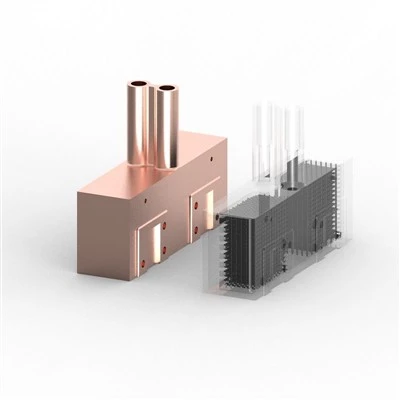
Traditional heat exchangers are constrained by shell-and-tube and plate-and-frame manufacturing, which often results in larger volume, dead zones, and lower volumetric heat transfer. Additive manufacturing removes most of those constraints.
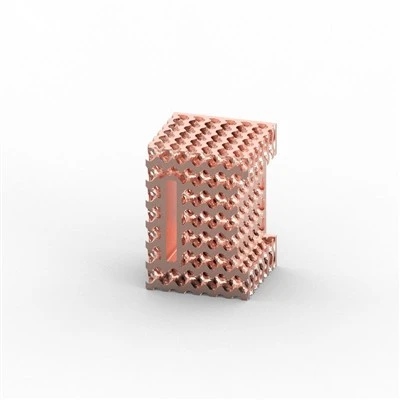
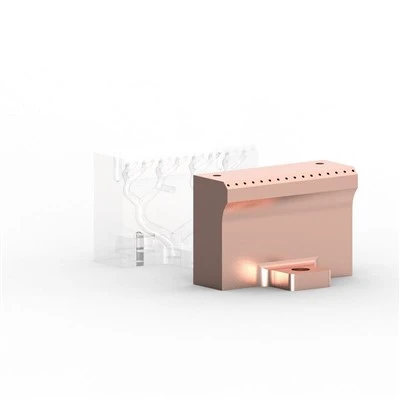
Through metal AM we integrate complex wavy, spiral, and TPMS-lattice channels into compact volumes. For a given external envelope, these geometries can increase the heat-transfer area by 30–60% versus conventional plate designs and induce favorable secondary flows that improve convective heat transfer.
Tested Performance Comparison
|
Key Metric |
3D Printed (TPMS / Lattice) |
Traditional Brazed Plate |
Typical Improvement |
|
Overall Heat-Transfer Coefficient U (W/m²·K) |
3,000–6,000 |
1,500–3,500 |
+50–100% |
|
Pressure Drop (kPa, equivalent duty) |
10–25 |
20–50 |
−30–50% |
|
Effectiveness ε (%) |
80–92 |
60–75 |
+15–25 pts |
|
Weight Reduction (vs. equivalent brazed unit) |
- |
- |
20–40% |
Values are typical ranges measured on water–water and water–oil duties at Reynolds numbers above 3,000. Absolute U-values depend strongly on fluids, flow rates, and fouling; we re-confirm performance for each application via CFD and bench testing.
Typical applications: high-power-density electronics cooling, compact liquid-cold plates, aerospace environmental control systems (ECS), and hydrogen fuel-cell thermal management.
Material Selection
Material choice drives corrosion resistance, thermal conductivity, and service life:
316L Stainless Steel -
General chemical, food-grade, and pressure-vessel applications. Excellent corrosion resistance and the most cost-effective option. Thermal conductivity of bulk 316L is ~16 W/m·K (3D-printed 316L typically 12–15 W/m·K).
01
AlSi10Mg Aluminum Alloy -
Lightweight aerospace and automotive cold plates. Thermal conductivity ~120–150 W/m·K (process- and heat-treatment-dependent), well suited to high heat-flux electronics cooling.
02
Ti-6Al-4V Titanium Alloy -
Medical, marine, and aggressive-chemistry environments. Very strong corrosion resistance and high specific strength.
03
Inconel 625 Nickel-Based Alloy -
Gas turbines and high-temperature chemical reactors. Retains useful mechanical properties at elevated temperatures (typical service to ~800 °C, with strength dropping above this range).
04
Pure Copper (CuCP) -
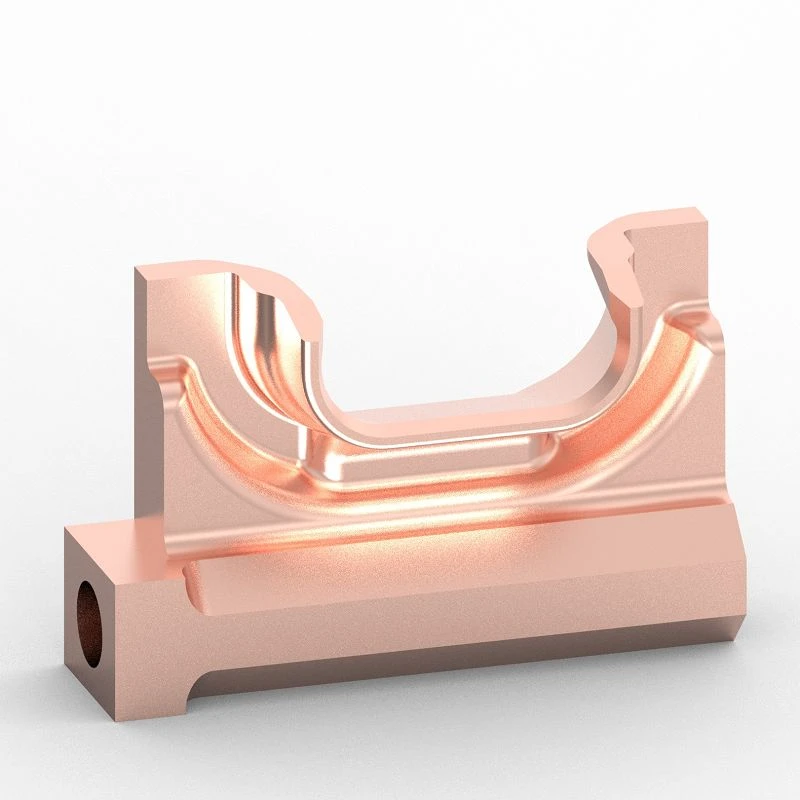
Where peak thermal conductivity is required: laser/electronics cooling, induction systems. Thermal conductivity ~390 W/m·K.
05
Lead Time & Customization
We recognize the value of speed in industrial R&D. Digitizing the heat-exchanger design and qualification path shortens the loop from concept to hardware:
Fast Response:
Free DFM thermal-design review; detailed quotation within 24 hours; sample production typically 7–14 working days for standard envelopes.
Deep Customization:
Minimum internal channel diameter ~0.8 mm (process- and orientation-dependent); interface options including NPT, BSP, flanges, and quick-connects; maximum build envelope up to 500 × 500 × 400 mm depending on platform.
Flexible Production:
The same qualified process documentation supports volumes from a single R&D sample to 500+ units per program - without tooling investment.
FAQ
Hot Tags: 3d printed heat exchangers, China 3d printed heat exchangers manufacturers, suppliers, factory