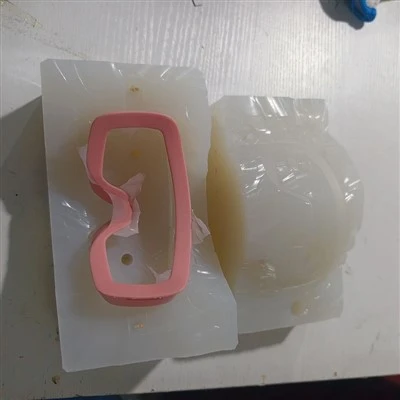
Urethane casting (also called vacuum casting) starts with a master pattern-usually 3D printed or CNC machined. Silicone is poured around the master under vacuum to create a flexible mold. Polyurethane resin is then mixed, degassed, and poured into the mold under vacuum. After curing, the part is demolded and finished. One silicone mold typically produces 15–25 good parts.
Injection molding uses a hard steel or aluminum tool. Molten thermoplastic is injected under high pressure into the closed mold, cooled, and ejected. The tool can run thousands or tens of thousands of cycles, but the upfront cost and lead time are significantly higher.
Both processes can deliver production-like parts, yet they sit at opposite ends of the volume and investment spectrum.
Side-by-Side Comparison
|
Factor |
Urethane Casting |
Injection Molding |
|
Tooling cost |
Low (silicone molds) |
High (steel or aluminum) |
|
Minimum order quantity |
1–5 pieces |
Usually 500–1,000+ |
|
Typical lead time |
7–10 days for first parts |
4–8 weeks for first parts |
|
Material range |
Polyurethane resins that simulate ABS, PP, PC, elastomers, etc. |
Full range of engineering thermoplastics |
|
Surface quality |
Excellent as-cast, easy to paint or texture |
Excellent, consistent over long runs |
|
Typical tolerance |
±0.2 mm on critical features (under 100 mm) |
±0.05–0.1 mm possible with tight process control |
|
Best volume range |
10–100 pieces (up to ~200 with multiple molds) |
1,000+ pieces |
|
Unit cost trend |
Decreases within mold life, then rises again |
High at low volume, drops sharply at scale |
Cost Break-Even Analysis
Urethane casting cost is driven mainly by the silicone mold and the labor for each pour. For a medium-complexity part, the first piece might land between $80–150, then fall to $25–45 once the mold is amortized over roughly 20 pieces. When volume exceeds one mold's practical life (usually 15–25 shots), additional molds are required and the unit cost rises again.
Injection molding carries a much higher fixed cost-often $5,000–25,000 for a simple single-cavity tool-plus material and machine time. At 50 pieces the amortized tooling alone can exceed $100–500 per part. At 5,000 pieces the same tool may bring unit cost below $3–8.
These figures are typical ranges for medium-complexity parts; actual urethane casting cost depends on geometry, material, and finish requirements and should be confirmed with a formal quote. For most geometries the break-even point sits somewhere between 300 and 1,000 pieces. Below that range, urethane casting is usually the lower-total-cost option and remains one of the strongest injection molding alternatives for low volume work.
Material and Performance Differences
Modern polyurethane resins can closely mimic the stiffness, impact resistance, and appearance of common injection-molded plastics such as ABS, PC, and PP. Clear grades approximate PMMA, and a wide range of Shore A elastomers cover soft-touch and sealing applications. Flame-retardant and higher-temperature grades are also available.
Cast urethane parts are not identical to their thermoplastic counterparts, however. Long-term creep, chemical resistance in aggressive environments, and extreme temperature performance can differ. UV stability and fatigue life may also lag behind true engineering plastics. Recommended wall thickness for most rigid grades is 1.5–4 mm; maximum part size is typically limited by chamber capacity (around 500 × 400 × 200 mm). For short-term prototypes, functional testing, and limited production these differences are rarely critical. For end-use parts that must survive years in harsh conditions, injection-molded thermoplastics remain the safer choice.
When Cast Urethane Parts Make Sense
Cast urethane parts are usually the better choice when you need:
10–100 functional pieces quickly
Production-like appearance and feel for customer or internal validation
Multiple design iterations without paying for new steel tools each time
Soft-touch, overmolded, or clear parts that are difficult or expensive to achieve with early injection tooling
A practical bridge between 3D printing and full production
This volume range is the practical sweet spot for low volume manufacturing of enclosures, covers, handles, lenses, and light structural components. Many product teams use our urethane casting service at this stage because it delivers consistent quality while keeping both schedule and budget under control. You can review available materials and process limits on our cast urethane parts page.
Compared with 3D printing, vacuum casting generally offers better surface finish, wider elastomer options, and lower unit cost once quantities move past a handful of pieces. Printed parts still win for highly complex internal geometry or true one-offs.
When to Switch from Urethane Casting to Injection Molding
It is usually time to move to injection molding when:
Annual volume is projected above 500–1,000 pieces
Unit cost must drop below what multiple silicone molds can achieve
The part requires a true engineering thermoplastic with certified long-term properties
Dimensional tolerances tighter than ±0.15 mm are mandatory across large features
The design is fully frozen and no further changes are expected
Quick transition checklist
Design freeze complete and signed off
Material specification locked (including any regulatory requirements)
Critical tolerances and surface requirements documented
Annual volume forecast exceeds the practical limit of silicone molds
Budget approved for hard tooling and longer lead time
If most of these points are true, start the injection-molding RFQ while finishing any remaining cast urethane batch for ongoing needs.
A Real Project Example
A medical-device startup needed 80 ABS-like housings with a painted Class-A surface for clinical evaluation and a major conference. Steel tooling would have taken eight weeks and cost more than the entire prototype budget. Using cast urethane parts, first articles were delivered in nine days. After minor gate and texture adjustments, the full batch of 80 pieces shipped with zero dimensional rejects on the sealing faces (verified by CMM).
The same geometry later transferred cleanly into production injection molds with only minor draft and gate changes. Had the quantity continued to climb past 150–200 pieces, we would have recommended evaluating multiple molds or moving directly to hard tooling to keep unit cost under control. Total time from approved CAD to functional parts was under two weeks-something injection molding could not have matched at that volume.
FAQ
Q: Is urethane casting cheaper than injection molding for low volume?
A: Yes in most cases below a few hundred pieces. The absence of expensive hard tooling keeps total project cost lower until volume rises enough to amortize steel molds.
Q: How many parts can I realistically get from silicone molds?
A: A well-made mold typically yields 15–25 good pieces. Multiple molds can be produced in parallel if higher quantities are required, though unit cost rises with each additional mold.
Q: Can I use the same CAD file for both urethane casting and injection molding?
A: In most cases yes. The same STEP or IGES file can be used for both processes. Minor adjustments for draft, gate location, or wall thickness may be needed when moving to hard tooling, but the core geometry usually transfers directly.
Q: When should I consider urethane casting vs 3D printing?
A: Choose 3D printing for complex internal features, one-off designs, or quantities under five pieces. Switch to urethane casting when you need better surface finish, elastomer options, or lower cost in the 10–100 piece range.
Conclusion
The choice between urethane casting vs injection molding is mainly a cost, speed, and risk decision rather than a pure quality contest. When quantities stay in the tens or low hundreds, cast urethane parts usually deliver the better balance of appearance, function, lead time, and total cost. Once volumes climb and the design is frozen, injection molding becomes the logical next step.
If you are evaluating options for 10–200 pieces, review the materials and process details on our custom cast urethane parts manufacturer page or send your CAD files for a quote. We can help you decide whether vacuum casting is the right bridge-or whether it is already time to move straight to hard tooling.