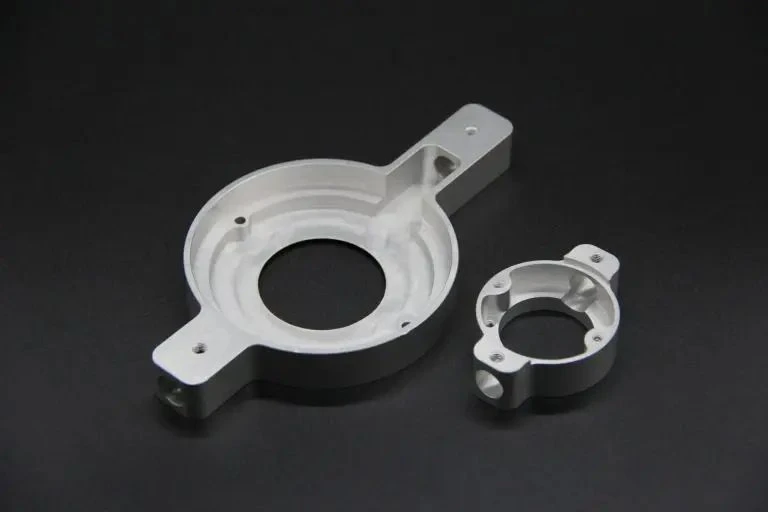

A product manager in Germany sent me a file last month. A housing for a medical hand switch, four hundred pieces, quote please. He had already priced CNC machining and resin 3D printing, and both were wrong for the job. CNC was three times his target, and the printed parts looked like prototypes instead of product. Vacuum casting landed at the right price with the right finish, and the whole order shipped in eleven days. That is the situation this process exists for, and the point of this article is to help you see it coming before you waste a week on the wrong quote.
What vacuum casting actually is
Vacuum casting is a silicone mold process for small batches of plastic parts. You start with a master model, machined or printed, and pour liquid silicone around it. The cured silicone becomes a flexible mold. Then polyurethane resin is poured into that mold inside a vacuum chamber, which pulls the air out so the resin fills every corner and detail. The result is a polyurethane part that copies the master with surprising fidelity. One silicone mold gives you roughly twenty to thirty parts before it wears out, which is exactly why the process lives in the range where injection molding is too expensive and 3D printing is too slow per part.
Where it beats CNC and 3D printing
The decision is mostly about quantity. For one to ten parts, 3D printing is usually the cheapest and fastest path. For thousands of parts, injection molding takes over. Vacuum casting sits in the gap between them, roughly twenty to five hundred parts, where it beats both alternatives. Against CNC, it wins on complex shapes, because machined housings need simple geometry while a cast part can copy undercuts and textures for free. Against 3D printing, it wins on surface finish, material feel, and unit cost at volume, because a cast polyurethane part behaves like a molded product, not a layered prototype. Many buyers who quote all three methods find vacuum casting is the only one that hits both the price and the look.
What the quote actually depends on
A vacuum casting quote is built from four lines. The master model comes first, machined or 3D printed, and its accuracy sets the ceiling for everything that follows. The silicone mold comes second, and it is the real engineering work, because the mold maker decides split lines, gate positions, and how to copy fine detail. Material comes third, and the range of polyurethane resins is wider than most buyers expect, from rubber-like soft grades to glass-filled stiff ones. Surface finish comes fourth, with options like painting, matte texture, and overmolding that change both the look and the price. A supplier who quotes without asking about quantity, part size, and finish is guessing, and the quote deserves exactly that much trust.
The numbers that matter on the datasheet
Tolerance is the first number to check. Standard vacuum casting holds around plus or minus 0.3 to 0.5 millimeters on most dimensions, which is fine for housings, brackets, and covers, and tighter than that requires either careful design or a different process. Hardness is the second number, measured in Shore A, from soft rubber-like parts at around 40 to rigid parts above 90, and the grade changes how the part feels and flexes. Wall thickness comes third, with a practical range around one to five millimeters, because thin walls flow poorly and thick sections risk voids in the pour. Temperature resistance is fourth, because standard resins sit well below what engineering plastics survive, and anyone who needs hot parts should say so before the mold is cut.
Lead time, samples, and the mold question
A serious vacuum casting supplier works fast, because the whole process is built around speed. The master model takes a few days, the silicone mold another day or two, and first parts can ship within a week of the final file. Samples before the bulk order are standard practice, and a sample confirms the color, the texture, and the dimensional check before you commit to the full batch. The mold itself is the one thing to keep straight: the silicone mold is not a production tool, it wears out after tens of parts, and the price of a new mold is normally included in each batch quote. A supplier who cannot explain the mold life and the sample policy clearly is a supplier you should probably skip.
How to screen a vacuum casting supplier
Ask the same questions you would ask any factory, and a few specific ones. Are you the manufacturer, and can we see the casting room on a video call? Which polyurethane grades do you stock, and can you send the datasheets? What tolerance do you guarantee on which dimensions? Can you match a specific color or texture, and do you offer painting in-house? What happens if a part fails your inspection after shipment, who replaces it, and who pays the freight? The best suppliers answer all of these in one message with references. The ones who talk only about price are usually the ones who disappear when the batch has a problem.
Quick answers on vacuum casting
How many parts make sense? Roughly twenty to five hundred, and the sweet spot is tighter than that. What materials can it copy? Polyurethane resins simulate ABS, nylon, rubber, and a range of flexible grades, though not every engineering plastic. Is it as strong as injection molding? Close enough for prototypes, testing, and low-volume production, and the gap narrows with a good resin grade. Can you get painted parts? Yes, painting and texture are common post-processes, and they are usually the difference between a prototype and a product. Is vacuum casting cheap? Per part, yes, at small volumes, and the real win is speed, because the first parts arrive before an injection mold is even quoted.
Send the file, get a real quote
Vacuum casting is the fastest way to turn a good 3D model into fifty or four hundred parts that look and feel like product, and the quote only takes a day. Send us your part file with the quantity, target material, and finish, and we will confirm the master model approach, the mold cost, and the lead time before you spend anything. Our vacuum casting service covers master model machining, silicone molds, polyurethane casting, and finishing in one workflow, and our engineers flag tolerance risks on your drawing before production starts. Upload the file through our inquiry form, or check the polyurethane casting material grades we stock, and get a quote that matches your part instead of a guess.